
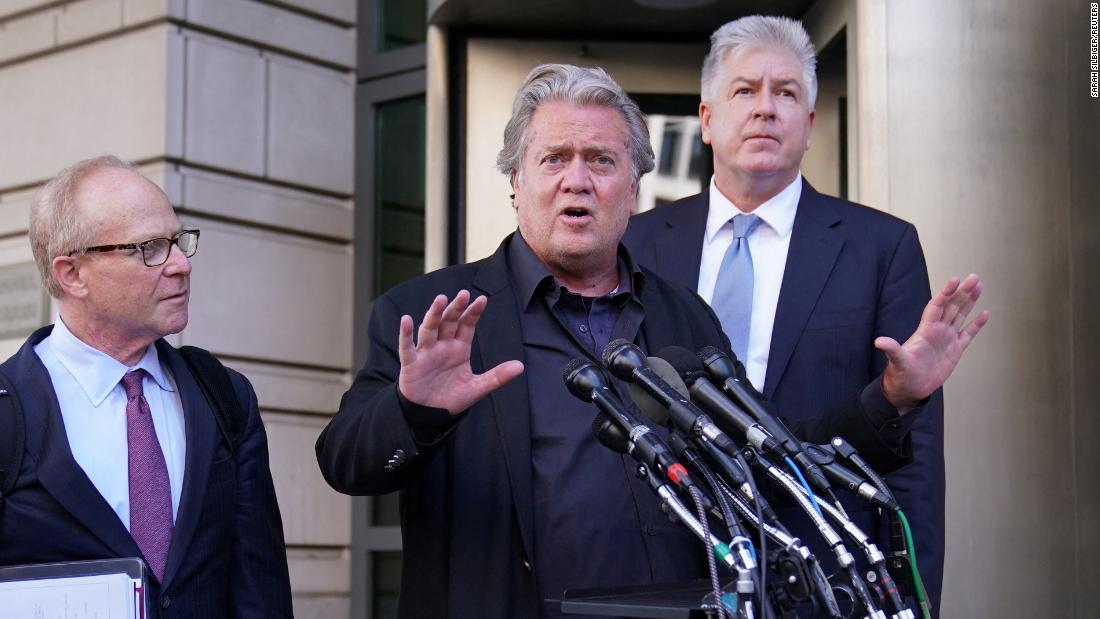
The simple case the prosecutor wanted to make was evident in the opening statement and questions to their first witness, the House Select Commission staff, who kept her testimony at a very basic level.
Banon’s team sought to muddy these areas with a hint of partisanship, both in the opening statement and in a fierce remark.
In the opening statement, prosecutor Amanda Bourne opposed the government’s order that Banon was obliged to obey citizens, telling the jury that “the defendant showed contempt for the U.S. Congress and the U.S. government, he said. I’m guilty. ” By not following the subpoena, Banon “prevented the government from obtaining the important information he needed.”
Bourne talks for about 20 minutes, explaining why the Commission Investigating the January 6, 2021 Rebellion was entitled to receive information from Banon, and a study shaping the legislation enacted by Parliamentary Commission. Explained how to do this and why this committee was particularly interested in obtaining information from Banon.
“Because it was a subpoena, Congress had the right to receive the information it asked for. It wasn’t optional. It wasn’t a request. It wasn’t an invitation. It was mandatory,” she said. Was emphasized. She refused why she suggested that Banon not cooperate.
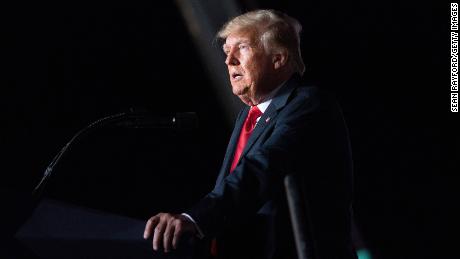
The cases that the prosecutors signaled they would wear are, in a sense, the product of some pretrial judgments in their favor from US District Judge Karl Nichols. He did not bring much of the evidence Banon tried to present-including most discussions about executive privilege. Instead, the Justice Department must prove that Banon has made a deliberate and deliberate decision not to appear in the requested testimony or to produce the requested document by a set deadline.
She assembled this case as one of “about the defendant blowing his nose in the orderly process of our government.”
“This is not a mistake,” she told the jury. “The defendant didn’t get the date wrong. He wasn’t confused about where to go. He wasn’t caught in a broken subway car. He just refused to obey the rules.”
Banon’s team plays politics
A long morning of intense legal debate from the Banon team led to a relatively short 15-minute opening statement from his counsel Evan Corcoran-and later a long public diatribe from Banon.
Corcoran’s opening statement was the first time the public and courts had heard of the complete defense framework of the Banon team after several days of protest. He explained to the jury that he would ask about negotiating a subpoena for Banon, and then hinted that a partisanship was underway when the House Select Commission summoned his client.
“The evidence was very clear. No one believed that Steve Bannon would appear on October 14, 2021,” Corcoran claimed.
He also asked the jury to look at evidence such as Banon’s subpoenas and insulting referrals and question, “Is this evidence influenced by politics?”
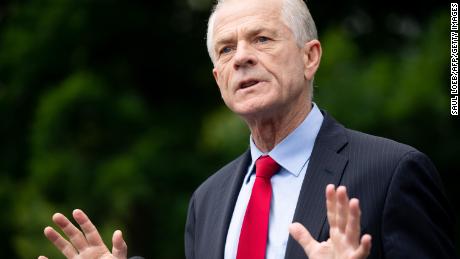
“I challenge Benny Thompson today to give him the courage to come to this court. If he intends to prosecute someone for a crime, he must be enough to appear here. “Bannon said.
The Banon team had previously tried to summon several house members to testify, but the judge did not allow it and removed one strategy that his team wanted to use. Still, depending on the staff’s testimony and how the rest of the prosecutor’s case progresses, it is unlikely that the judge will reconsider Banon’s desire to call Thompson to testify.
Candid testimony from committee staff
The testimony so far has been as easy as a prosecutor could do, as the first witness of the Justice Department concludes the afternoon.
Did Banon set a record by the deadline for the subpoena on October 7th?
“He didn’t,” said Christine Amarling, deputy staff director of the committee.
Did Banon appear for testimony as a subpoena was requested on October 14th?
“He didn’t,” Amarling said again in the Witness Box.
The testimony highlighted how the Justice Department tried to simplify the jury’s allegations. This includes expressing the work of Congress in the most basic language.
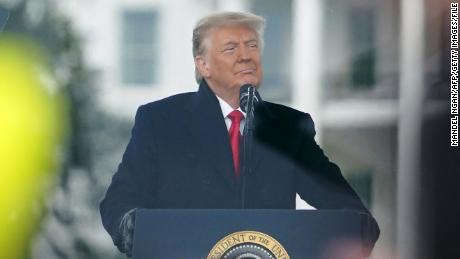
Amerling also explained the House Commission parameters and how they work. She talked about the fact-finding work that needs to be done urgently because “the threat to our democratic system continues”. And she explained how the Commission searched for Banon for contact with Trump and others in Trump’s circle, including the Willard Hotel before the January 6 riots-attached to the summons. The Commission’s open letter to Banon contains all the details.
Amerling will be back for further testimony on Wednesday morning.
Verdict may come before Thursday’s prime time hearing
Much of the Banon trial drama was about that timing.
Is this trial short and simple (as the prosecutor predicts) or long and complex (like Banon’s hope)? Will it be delayed by more than a month, or can it even go to deliberations before the Prime Time hearing of the elected Commission on Thursday night?
Banon has failed several attempts to postpone this week’s trial. On Tuesday morning, his lawyer called for a one-month delay after a fierce legal debate over what evidence could be presented in the case.
Also, the Banon team’s proposal to delay the trial by just a few days did not gain real traction. At one point, Nichols suggested that he might have to wait until Wednesday to start a full-scale trial, as the parties struggled to come up with a plan to deal with certain evidence. But in the end, the discussion took only a few hours to process, and the opening statement could begin by mid-afternoon.
Only a handful of witnesses have been identified in both court plans, which means that the procedure will still take several days. The question is whether Banon’s accusations will be considered by a jury before the Commission’s hearing on Thursday, January 6.
Source: www.cnn.com

