
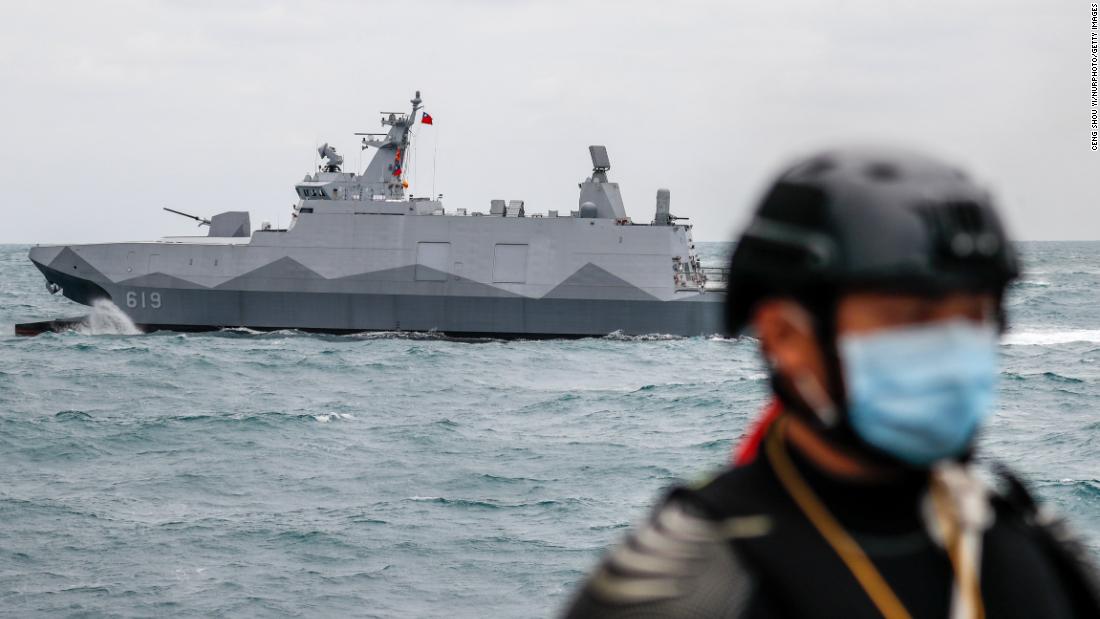
Less than a decade ago, the relationship appears to have been restored as economic, cultural and even political involvement deepened on both sides, separated by a strait less than 80 miles (128 km) wide at the narrowest point. I did. But today, the relationship is at its lowest point in decades-although experts warn that an imminent full-scale war is unlikely, it raises the risk of military expansion.
In recent months, China’s implicit support for Russia’s invasion of Ukraine only fuels speculation about Beijing’s intentions for Taiwan, questioning how the world would react if China launched an attack. I am raising it.
The White House quickly downplayed Biden’s comments, but no other country is as deeply involved in the conflict as the United States, which has a complex history and a long and delicate middle ground.
China’s authoritarian shift under Xi Jinping’s leadership and the plunge with Washington brought Taiwan closer to the US trajectory. This infuriated Beijing, further releasing pressure on Taiwan and spurring cross-strait relationships into a downward spiral.
Here’s what you need to know about the islands at the forefront of the US-China conflict:
First, a brief history
Taiwan, where the indigenous people lived for a long time, became part of the Chinese empire in the 17th century. Then, after the Chinese Empire was defeated by the Sino-Japanese War, it was transferred to Japan in 1895.
The island remained a Japanese colony for half a century until the end of World War II. Following Japan’s defeat by the Allies, China’s dominant national government, led by the Kuomintang (KMT), dominated Taiwan.
Shortly thereafter, nationalists who ruled the mainland under the banner of the Republic of China (ROC) after the collapse of the Chinese Empire were newly attacked by the rebellious Chinese Communist Party (CCP).
Both sides plunged into a bloody civil war, eventually defeating the nationalists who fled to Taiwan and moving the seats of the Government of the Republic of China from Nanjing to Taipei. Beyond the straits, the CCP came to power and established the People’s Republic of China (PRC) in Beijing.
Both have declared themselves to be the only legitimate government in the entire Chinese territory.
In Taipei, nationalist leader Chiang Kai-shek dreamed of regaining the mainland one day. In Beijing, CCP Chairman Mao Zedong regarded Taiwan as the last piece of unified “New China.” This is a “problem” that needs to be resolved sooner or later.
However, since the democratization of Taiwan in the 1990s, Taipei has downplayed its territorial claims to mainland China.
Today, Taiwan is a vibrant democracy, home to more than 23 million people, and has its own army, currency, constitution, and elected government.
However, it is not recognized as an independent country by most governments in the world and is diplomatically increasingly isolated.
Over the years, more and more governments have switched diplomatic recognition from Taipei to Beijing, leaving Taiwan with 15 diplomatic allies at the end of 2021.
What is the role of the United States in all of this?
During the Chinese civil war, the United States supported nationalists while the Communists received support from the Soviet Union.
However, following the diplomatic dispute between Beijing and Moscow in the 1960s (known as the Sino-Soviet Conflict), relations between China and the United States began to break to offset the Soviet Union.
By 1979, the United States had joined the growing list of countries to formally switch diplomatic approval from Taipei to Beijing.
Meanwhile, the United States continues to maintain a close and informal relationship with Taiwan under the Taiwan Relations Act decades ago, and the American Institute in Taiwan (AIT) (the de facto US embassy in Taipei). ) Promotes commercial, cultural and other exchanges.
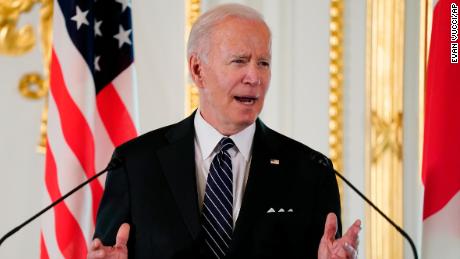
Washington also supplies the island with defense weapons, but it remains deliberately ambiguous as to whether to protect the island in the event of a Chinese invasion. This is a policy known as “policy ambiguity.”
It aims to contain the confrontation by deterring China by leaving the potential of the US military’s response open. At the same time, it aims to deprive Taiwan of US guarantees that may encourage Taiwan to declare official independence. The goal was to maintain the status quo and avoid war in Asia, which worked well and allowed Washington to develop a close relationship with both sides.
But under Biden, that “policy of deliberate” is a little less ambiguous. Biden has said three times that the United States would be willing to intervene militarily in the event of a Chinese attack since his inauguration, but the White House hastily retreated his remarks each time.
But his recent warning to Beijing has brought even more symbolic weight. It was done right at the doorstep of China during its first trip to Asia as President with the aim of uniting his allies and partners to counter China’s growing influence.
As expected, Beijing responded angry to his remarks, expressing “strong dissatisfaction and strong opposition” and accusing the United States of “playing with fire.”
Why are you getting nervous?
For decades since China’s founding, hostility dominated between Beijing and Taipei, with trade, travel and communications largely cut off. Military conflicts continued to intensify, with China bombarding several remote islands dominated by ROCs on two separate occasions.
However, tensions began to ease in the late 1980s, allowing limited personal visits, indirect trade and investment throughout the strait. Relations peaked in 2015 during a historic meeting between KMT and CCP leaders in Singapore.
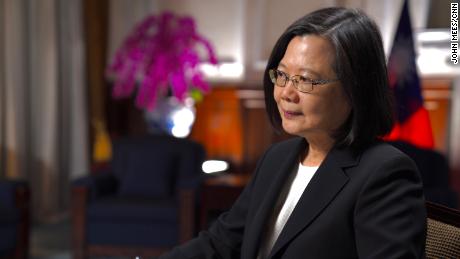
However, relations have deteriorated rapidly since 2016, when Tsai Ing-wen, a traditionally independent Democratic Progressive Party (DPP), won the landslide presidential election in Taiwan. This was boosted by voters’ concerns that Taiwan was too close to Beijing under the KMT administration. ..
And under Xi, China became more and more active in foreign policy and more authoritarian at home. A relentless crackdown on democracy and freedom in Hong Kong further alienates many Taiwanese who fear they may face the same fate as they would under Beijing’s control.
Tensions are particularly heightened as Chinese troops increase pressure on the island in response to what Beijing considers to be a “provocation” by the Taiwanese and US governments.
How likely is it to compete?
After an aggressive military exhibition from Beijing in 2021, Taiwan’s defense minister warned that China could launch a “full-scale” invasion of Taiwan by 2025.
Bonnie Glazer, director of the Asian program at the German Marshall Foundation in the United States, said China’s military operations and training cautioned Taiwan and the United States not to cross Beijing’s red line. .. She said these red lines included a formal campaign for Taiwan independence and a decision to deploy a large number of US troops on the island.
On Monday, Biden repeated such an assessment.
“My expectation is that it won’t happen,” he told reporters. “It won’t be tried.”
It makes sense to aim for a peaceful solution of standoffs across the Taiwan Strait-experts have long said that Beijing’s attempt to forcibly seize the island has been a very costly endeavor and the result. Has stated that it is uncertain.
In addition, experts said the swift and coordinated response from the United States and its allies to Russia’s invasion of Ukraine was likely to have alerted Beijing, with its leaders west of Ukraine with Taiwan in mind. It suggests that we are seeing the reaction of.
It is not yet known what lessons Beijing will draw from the Ukraine crisis. The calculation could be more cautious in the light of Russia’s violent aggression and the strong reaction of the West.
But on the other hand, Beijing also said, “Taiwan will be serious about defense, and the United States and its allies may be serious about preparation, so attempts to force the island will become more difficult as the waiting time increases. You can also conclude, “Let’s do it.” With Taiwan for that fight, “written Bill Bishop, a Chinese political expert and author of the Sinocism newsletter.
Stephen Collinson of CNN contributed to this story.
Source: www.cnn.com

